
EXECUTIVE SUMMARY
The Universal Project (U.P.) is a catalytic model for advancing global cooperation: it harnesses collective action, channels public and private resources into a visible annual flagship, and delivers measurable outcomes that foster trust, unity, and systemic change. For policy leaders seeking scalable, credible vehicles for global progress—especially in a time of fragmentation and limited resources—the U.P. offers a blueprint for impact, innovation, and cross-continental collaboration.
Read the 21 Reasons why Givingtide has a U.P.
INTRODUCTION
In the age of global challenges, the test of leadership is not merely the ability to manage, but the courage to unite. As Kofi Annan urged international leaders, “You can do anything, but not everything.” The Universal Project embodies this wisdom—focusing diverse strengths, ambitions, and resources on one shared challenge each year.
The Universal Project is not simply a financial tool—it is an instrument for forging global resilience, demonstrating effective cross-sector coordination, and building the public trust vital to any ambitious agenda. By carrying out a single, visible act of shared generosity annually, policy leaders send a signal: the world can overcome fragmentation when vision and will converge, and systemic change is possible when the many act as one.
Here are the detailed reasons why Givingtide promotes a U.P. each year:
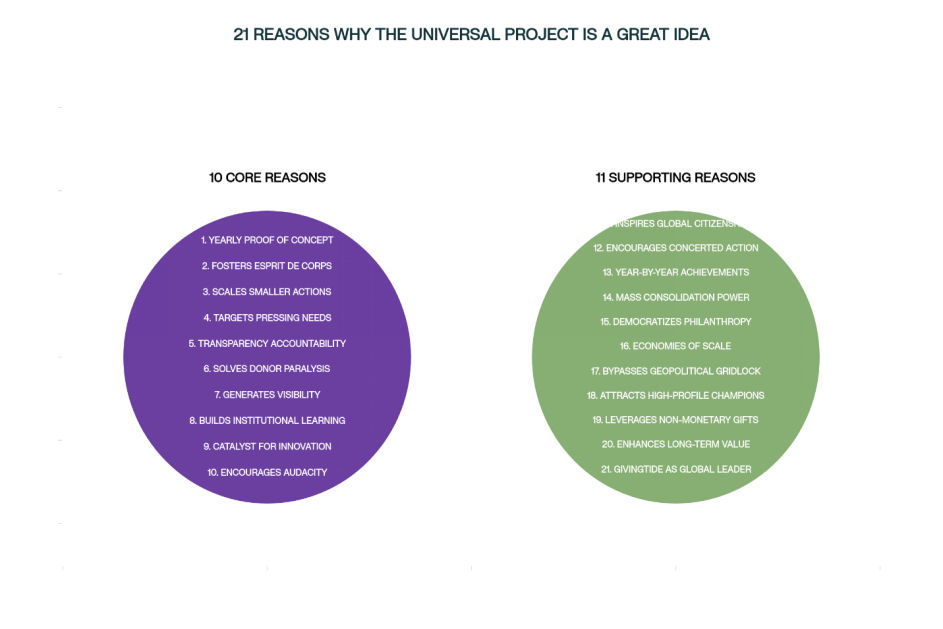
- It is A Yearly “Proof of Concept” for Skeptics
A Universal Project (U.P.) functions as an annual, visible proof of concept that the broader 1% giving can work. While systemic change from a permanent 1% commitment may take years to materialize, a single, well executed project each year delivers immediate, undeniable results. Those annual wins build trust, convert skeptics, and keep the movement energized—without undermining donor choice. The U.P. creates a rhythmic cycle of anticipation, action, and celebration that renews commitment, attracts media attention, and turns one time testers into long term advocates.
Why this matters (concise reasons):
- Short term, visible wins: Annual projects produce tangible outcomes donors can see and cite within a year, proving the model’s effectiveness.
- Momentum and trust building: Repeated, measurable successes convert skeptics into supporters and strengthen credibility for the long term giving.
- Sustains donor engagement: Fresh yearly goals prevent message fatigue and keep supporters emotionally and practically invested.
- Try before you buy for hesitant donors: Discretionary gifts to the U.P. let cautious donors test the approach without committing to permanent allocations.
- Risk pooling and efficiency: Aggregated contributions lower transaction costs, spread implementation risk, and enable larger, more effective interventions.
- Catalytic leverage: A visible, well funded project attracts co funders, governments, and institutional partners, multiplying the original gifts’ effect.
Operational predictability for partners: Implementers can plan at scale with predictable funding windows, improving procurement, staffing, and outcomes.
Summary: The U.P. turns long term ambition into annual proof—energizing donors, proving impact, and accelerating the transition from skepticism to sustained commitment.
“Action is the real measure of intelligence.” — Napoleon Hill
2. It Creates a Shared Global Flagship that Unites All Givers, Fostering a Global “Esprit de Corps”
A universal project gives all signatories—rich or poor, large or small—a shared mission each year. This transforms Givingtide from a fragmented set of individual efforts into a cohesive global movement, just as the Olympics or World Cup unite nations around a common platform despite deep differences.
This cultivates a sense of worldwide interconnectedness by bringing diverse givers together around a single, high-impact cause. In a fragmented world, this unified response to a critical need bridges divides of culture, geography, and ideology—demonstrating humanity’s capacity for collaborative generosity and shared purpose.
The U.P. will aim to ultimately achieve the status of international rituals such as the Olympics or the World Cup, creating a rhythmic “philanthropic season,” a moment when communities everywhere act in concert. Whether donors are in Tokyo, New York, Enugu, or Buenos Aires, contributing to the same universal project instills a powerful sense of global citizenship and belonging. This collective action forges psychological bonds, creates symbolic unity, and embodies the ethos of universal solidarity—showing that institutions worldwide can stand together for the common good. Dispersed giving cannot achieve this universal psychological bond of global citizenship.
“Coming together is a beginning, keeping together is progress, working together is success.”
3. It Converts Collective Smaller Actions into Exponential Impact
Concentrating global donations on a single, carefully chosen Universal Project (U.P.) each year turns many small, scattered gifts into a single, high impact investment, amplifying collective impact through focus. The result is a multiplier effect: clarity attracts partners, pooled scale unlocks better terms, and concentrated funding enables outcomes that fragmented giving rarely achieves.
Marginal gifts are amplified; when aggregated, even modest donations compound into a resource pool large enough to make real, documented change, encouraging widespread involvement.
When different institutions contribute—at any scale—toward one strategic initiative, impact compounds dramatically. The whole becomes far greater than the sum of its parts.
“Great things are done by a series of small things brought together.” — Vincent van Gogh
4. It Allows Givingtide to Target the World’s Most Pressing Needs
The Universal Project enables the movement to focus global attention and resources on the most urgent and high-leverage problems each year, based on ten transparent criteria. Each year’s project can address shifting global priorities—emerging crises, scientific opportunities, or chronic challenges—ensuring philanthropy adapts and responds with agility.
Corollary – Spotlighting Neglected Crises: Media attention often fixates on the “crisis of the week,” leaving chronic, silent emergencies underfunded. The selection of the U.P. has the power to direct the “Eye of Sauron”—global media and public attention—toward these neglected issues, educating the public and generating empathy for causes that lack a marketing budget. This focused visibility can drive greater engagement and mobilize additional resources and support.
Corollary – Dynamic Responsiveness to Emerging Crises: Endowments and government budgets are often tied up in multi-year cycles and bureaucratic red tape. The U.P. is agile. Each year, it can pivot to address the most urgent “bleeding wound” of the world—whether it is a sudden refugee crisis, a famine, or a climate disaster. It provides the global community a mechanism to be responsive and relevant in real-time.
“It is not the strongest of the species that survives, nor the most intelligent; it is the one most adaptable to change.” — Charles Darwin
5. It Ensures Transparency and Accountability at the Highest Level
A single, highly scrutinized, globally monitored project builds trust. By establishing and publishing rigorous criteria for impact, need, and reporting, the Universal Project ensures transparent, merit-based selection. This openness makes it possible for donors to see exactly how and why projects are chosen—and how their contributions are used—thereby reducing skepticism, promoting accountability, and fostering lasting trust.
Transparent selection and clear reporting mechanisms allow all participants to track impact in real time, build confidence in the process, and showcase results for future giving. This accountability transforms one-time contributors into long-term supporters by raising donor confidence, encouraging ongoing engagement, and demonstrating that funds are always directed to the most effective, high-need solutions.
A dedicated transparent structure (Givingtide Trust + independent corporate trustees) ensures that all contributions are handled with the highest standards. This encourages more donors to join and stay.
Corollary: Benchmarking Global Standard for Transparency and Reporting: Because the U.P. is guided by “transparent criteria for impact, need, and reporting,” it acts as a global benchmark. The selected project must adhere to the highest standards of accountability because the whole world is watching. This creates a “race to the top,” forcing NGOs and projects to upgrade their own transparency measures to compete for future consideration as a Universal Project.
“Sunlight is said to be the best of disinfectants.” — Louis Brandeis
6. It Solves the “Decision Paralysis” of Donors
One of the biggest barriers to giving is not a lack of generosity, but a lack of clarity. Donors are often overwhelmed by thousands of worthy causes and fear making the “wrong” choice. The U.P. removes this cognitive friction by offering a pre-vetted, high-impact option. It serves as a “default setting” for generosity, unlocking funds that would otherwise remain dormant due to indecision.
Corollary: It Provides a Clear On-Ramp for New or Small Donors: Some nations, corporations, and small foundations struggle to identify credible, high-impact projects.
The Universal Project offers a turn-key opportunity that allows low-capacity givers to immediately participate meaningfully. No research barriers. No due-diligence burden. Just impact.
“More is lost by indecision than wrong decision.” — Marcus Tullius Cicero
7. It Generates Massive Visibility, Momentum, and Media Attention
A single global project per year becomes a focal point for storytelling, media campaigns, celebrity endorsements, and philanthropic diplomacy. This drives awareness, participation, and excitement—essential for scaling the movement.
Universal visibility turns isolated generosity into a global movement—because concentrated stories and measurable wins are what media, peers, and the public rally around.
A focused annual campaign converts many small acts into one newsworthy narrative. Massive media attention follows clarity: journalists, influencers, and civic leaders can explain one concrete goal far more easily than dozens of scattered causes. That clarity fuels peer influence—organizations copy what they see working—and viral support: a single compelling story, image, or metric spreads quickly on social platforms. The result is positive feedback: visibility drives participation; participation increases impact; impact creates more visibility.
How universal visibility multiplies effect
- Clear, newsworthy narrative — A single, well framed project gives reporters and storytellers a simple hook: a measurable goal, a timeline, and human stories that make abstract giving tangible.
- Peer pressure becomes peer inspiration — When respected institutions publicly back the U.P., others follow; public endorsements create social proof that accelerates sign ups.
- Amplified fundraising efficiency — Marketing and outreach concentrate on one message, lowering costs per dollar raised and increasing conversion rates.
- Attracts strategic partners — Corporations, governments, and foundations prefer visible, high impact opportunities; a focal project draws co funders and in kind support.
- Easier measurement and storytelling — One project enables crisp metrics and compelling before/after narratives that media and donors can celebrate.
- Mobilizes grassroots and digital virality — A single call to action is far more shareable on social platforms, enabling rapid, low cost amplification.
Key takeaway: Visibility is not vanity; it is leverage. A single, well-chosen U.P. turns storytelling into scale, and scale into systemic change—because people give to stories they can understand and share.
“There is only one thing in the world worse than being talked about, and that is not being talked about.” — Oscar Wilde
8. It Builds Institutional Memory and Global Learning
By concentrating resources on one initiative, the project enables rigorous tracking and evaluation, yielding data-driven insights that refine future selections and demonstrate philanthropy’s real-world efficacy, building evidence for the overall Givingtide model.
Annual flagship projects produce case studies, lessons learned, and best practices that strengthen philanthropy worldwide. The world gains a shared repository of knowledge on how to solve global problems effectively.
Corollary – A Blueprint for Future Initiatives: The Universal Project sets a precedent for future collaborative efforts in philanthropy. It demonstrates a scalable model for addressing pressing global issues, encouraging similar initiatives that can focus on specific needs across various sectors and geographies.
“We do not learn from experience… we learn from reflecting on experience.” — John Dewey
9. It is a Catalyst for Innovation (“the Wisdom of the Crowd”)
Focusing global attention and pooled funds on a single, high need challenge turns the Universal Project into an engine of breakthrough thinking. When diverse donors, practitioners, and researchers concentrate resources and attention on one problem, they create the conditions for rapid experimentation: bold pilots, cross sector partnerships, and risk tolerant bets that individual donors rarely underwrite alone.
- Concentrated risk capital — Aggregated funding lets implementers try higher risk, higher reward approaches that would be impossible with fragmented small grants.
- Cross disciplinary collision — Bringing together philanthropies, governments, NGOs, and private innovators sparks creative combinations of technology, policy, and community practice.
- Fast, rigorous piloting — A single project enables well resourced pilots with robust monitoring, so promising solutions can be tested, refined, and scaled quickly.
- Knowledge transfer at scale — Successful interventions produce replicable toolkits, open data, and governance models that other regions can adapt, accelerating global diffusion.
- Signal that attracts talent — A visible, well funded challenge draws researchers, social entrepreneurs, and corporate partners who want to work on meaningful, solvable problems.
By concentrating resources and attention, the U.P. creates a laboratory for social innovation: ideas are funded, rigorously tested, and amplified. The result is not just relief but repeatable, scalable solutions that tackle the world’s toughest challenges.
“None of us is as smart as all of us.” – Ken Blanchard
10. It Encourages Audaciousness by Making Room for High-Risk, High-Reward Ideas
The Universal Project allows Givingtide to champion bold, frontier ideas (like Preemptology) that individual donors might avoid due to perceived risk.
Collective backing spreads risk and unlocks innovation that transforms systems.
“Only those who will risk going too far can possibly find out how far one can go.” — T.S. Eliot
11. It Inspires Global Citizenship and Borderless Statesmanship
Highlighting an annual Universal Project elevates public awareness of global challenges, educates participants about critical issues, and instills a sense of shared responsibility for the world’s most urgent needs.
“I am not an Athenian or a Greek, but a citizen of the world.” — Socrates
12. It Encourages Other Concerted Action
A universal project fosters a sense of community among diverse donors. It brings together individuals, corporations, and organizations under a common banner. By demonstrating and reinforcing the idea that together, we can effect significant change, it encourages givers to unite together to accomplish other big wins apart from the U.P.
A Universal Project (U.P.) does more than raise money for a single cause; it creates a social and operational platform that makes further collective action easier, faster, and more likely. By convening diverse donors around one visible success, the U.P. turns isolated generosity into a repeatable model for cooperation—seeding networks, norms, and capabilities that scale beyond the annual project.
How the U.P. catalyzes additional collective wins
Creates a shared identity — Participating institutions gain a common label and story, which lowers barriers to future collaboration and makes joint initiatives feel natural rather than exceptional.
Builds trust through delivery — A well executed U.P. produces proof that partners can work together and achieve results, reducing the perceived risk of new joint ventures.
Generates reusable networks — Relationships formed for the U.P. (implementers, funders, governments, media) become an ecosystem that can be redeployed for other priorities.
“If I have seen further, it is by standing on the shoulders of giants.” — Isaac Newton
It Creates a Legacy of Year-by-Year Global Achievements
Over decades, the Universal Projects will form a library of historic achievements:
perhaps one project to strengthen global health,
• another to advance climate resilience,
• another to empower girls’ education,
• another to transform early childhood development…
This becomes a living monument of humanity’s shared commitment to solving its greatest challenges.
This Legacy and cumulative narrative build a cumulative story of progress that strengthens the movement’s brand and long term appeal.
“The world is my country, all mankind are my brethren, and to do good is my religion.” — Thomas Paine
14. It Unleashes the Power of Mass Consolidation (The “Tipping Point” Effect)
Philanthropy is often fragmented, with resources diluted across thousands of disconnected initiatives. By directing a massive, voluntary wave of funding toward a single focal point annually, the U.P. creates a “capital tipping point.” This allows for the rapid completion of massive infrastructure projects that would otherwise languish for decades under piecemeal funding.
“Little drops of water, little grains of sand, make the mighty ocean and the pleasant land.” — Julia Carney
Corollary: It Minimizes Duplication and Waste
Coordinated giving toward high-quality, vetted initiatives reduces the risk of fragmented, duplicative, or inefficient efforts—ensuring maximum efficiency and avoiding “charity fatigue.”
“The essence of strategy is choosing what not to do.” — Michael E. Porter
15. Democratizing Philanthropy (The “Every Penny Counts” Reality)
The 1% Equity Giving particularly targets the wealthy “haves.” The U.P., by stating “no amount… will be deemed too small,” invites the entire global population to participate. This creates a sense of universal ownership. When a student’s $5 donation joins a corporation’s $5 million donation in the same pot, it validates the student’s agency and reinforces the ethos that solving global problems is a collective human endeavor, not just a rich person’s burden.
By allowing anyone to give any amount, the Universal Project welcomes participants regardless of means—engaging individuals, corporations, and nations alike and creating a truly inclusive philanthropic movement, so that even modest contributors to feel part of a historic effort.
Participation remains voluntary and discretionary, so donors retain agency while benefiting from collective scale.
“Not he who has much is rich, but he who gives much.” — Erich Fromm
16. Economies of Scale in Impact Delivery
When procurement is centralized for a single massive project (e.g., buying 50 million solar panels to provide alternative power for an entire nation), the purchasing power drives costs down significantly. The U.P. creates a “wholesale” philanthropy model where every dollar goes further than it would in a “retail” charity model, maximizing the efficiency of the collective fund.
“Scale is not just a matter of size—it’s a matter of strategy.” — Arundhati Bhattacharya
17. It Bypassing Geopolitical Gridlock
Bilateral aid (Country A giving to Country B) is often bogged down by political strings, sanctions, or diplomatic posturing. The U.P. acts as a neutral, humanitarian buffer. Because donations flow into a collective “Universal” pot based on need rather than political alliance, it allows citizens of rival nations to contribute to the same humanitarian goal without the baggage of state-level diplomacy.
“Diplomacy is the art of letting someone else have your way.” — David Frost
18. It Attracts and Retains High-Profile Champions
A spotlight project draws celebrities, influencers, and leaders who might otherwise stay on the sidelines, leveraging their platforms to amplify visibility and recruit more donors, creating a virtuous cycle of growth for the movement.
“Leadership is the capacity to translate vision into reality.” — Warren Bennis
19. It Leverages Non-Monetary Contributions
Beyond financial donations, a universal project can solicit various forms of support, such as skills, expertise, or advocacy. This broadens the scope of engagement and allows for a richer exchange of resources, enhancing overall impact.
“Everybody can be great because anybody can serve.” — Martin Luther King Jr.
20. It enhances Long-Term Sustainability
A visible, well funded universal project attracts co funders, governments, and investors, multiplying the original gifts’ effect (Catalytic leverage).
Focusing on a universal project encourages ongoing support and investments. By committing to a specific initiative over time, donors can contribute to its sustainability and success, allowing for meaningful progress rather than short-term fixes.
“Sustainability is no longer about doing less harm. It’s about doing more good.”
—Jochen Zeitz
21. It Positions Givingtide as a Global Leadership and Lead Advocate of Philanthropy
By showcasing a commitment to a universal cause, Givingtide demonstrates that it is the unifying leader of global philanthropy. This moral leadership can inspire others to participate in collective action, fostering a culture of generosity and social responsibility worldwide.
“A leader is one who knows the way, goes the way, and shows the way.” — John C. Maxwell
CONCLUSION
The Universal Project is a standard-setting mechanism, inviting governments, corporations, and civil society to co-invest and co-own real progress. As Nelson Mandela reminded leaders worldwide, “It always seems impossible until it’s done.”
The choice is not between caution and recklessness, nor between self-interest and solidarity. It is between scattered inertia and united leadership. The Universal Project offers the clarity, transparency, and unity needed for united global action. For those whose decisions shape nations and markets, it is a call to stand at the forefront of constructive history—demonstrating that collective action can still make what was once impossible, inevitable.
“Shaping New Currents of Hope”