
Equity Giving: 21 Reasons Why 1% To The Poorest 10% Serves Everyone
AI generated image; for Givingtide’s illustrative purposes only

Executive Summary
Equity Giving—dedicating at least 1% of resources to the world’s poorest 10%—is an investment in collective safety, prosperity, and resilience. The twenty-one reasons demonstrate that this commitment is not just philanthropy, but smart policy: the highest return on investment, a stabilizer of markets and democracies, a preemptive force against future crises, and a builder of reputational and long-term institutional value. As risks and opportunities cross continents and eras, targeting our giving at the hardest margins is both the most efficient and most just use of global resources. For policy makers, the 1% giving transforms generosity from charity into strategy—and from strategy into legacy.
Introduction
Every nation, corporation, and foundation faces a shared reality: extreme poverty destabilizes the world we all inhabit. Givingtide invites institutions to give just 1% of their annual resources—whether GNI, net revenue, or endowment—to uplift the poorest 10% of the global population. This commitment is not charity; it is enlightened self-interest grounded in strategy, resilience, and moral clarity. Below are 21 compelling reasons why this modest investment yields transformative returns for all.
“Ubuntu: I am because we are. My humanity is bound up in yours, for we can only be human together.” — Archbishop Desmond Tutu
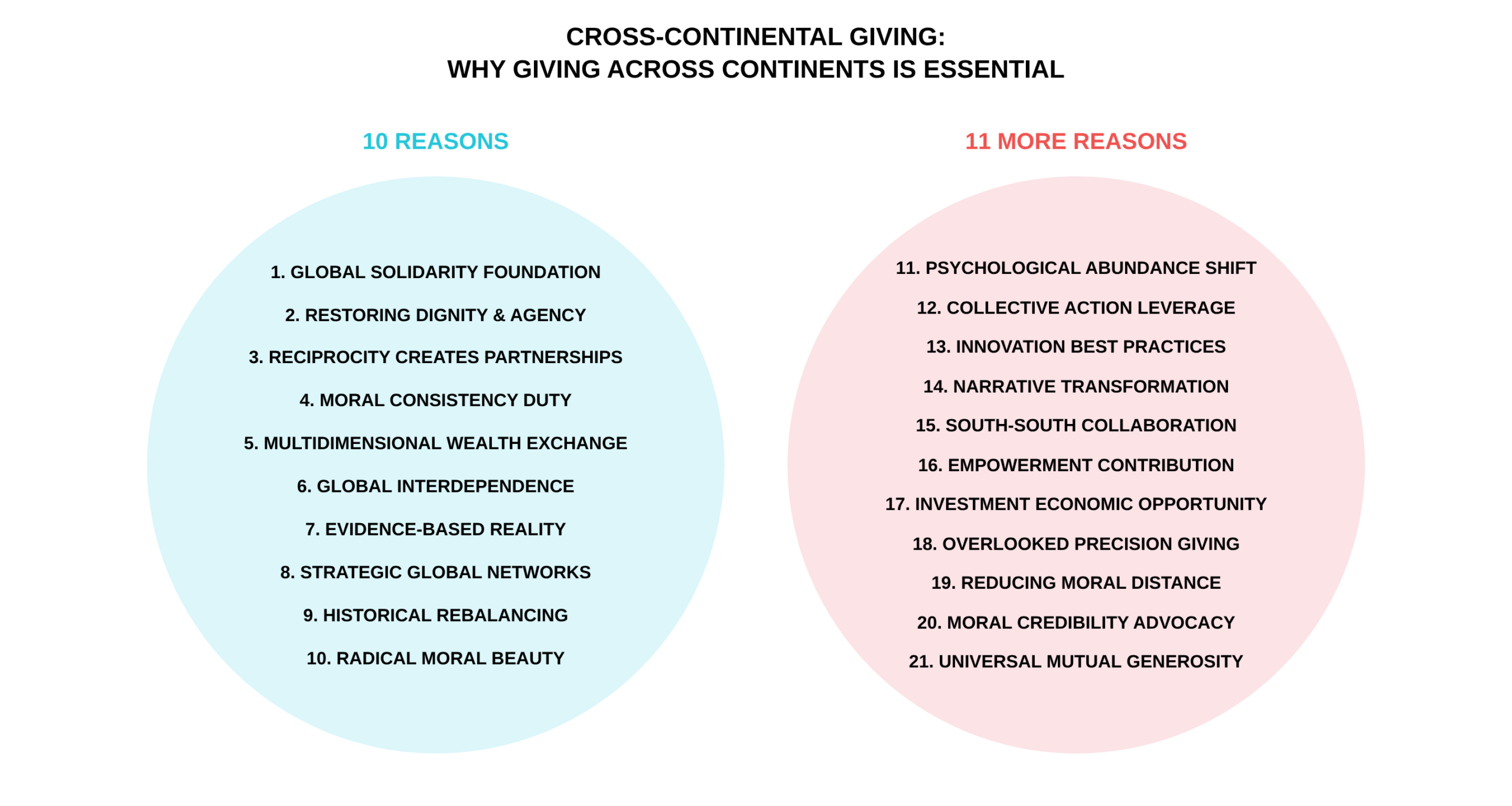
THE 10 CORE REASONS
1. Highest Return on Investment in Any Asset Class
Funds directed to the bottom 10% deliver documented social returns of 15:1 to 60:1 over a generation—outperforming hedge funds and traditional investments. This exceptional return stems from a fundamental reality: prosperity is not evenly distributed in its impact. Moving an individual from the lowest to the second-lowest income quintile increases life expectancy by 3.4 years, whereas equivalent income gains at the top yield minimal health improvements. Equity Giving ensures resources flow where they generate the most profound human return per dollar spent—across health, education, equity, nutrition, and economic empowerment. By narrowing disparities rather than merely raising the global average, we acknowledge that the greatest leverage lies at the margins.
“We all do better when we all do better.” – Senator Paul Wellstone.
2. Global Stability as the Foundation of Prosperity
Extreme poverty is the primary driver of instability, conflict, mass migration, and geopolitical crisis. When the poorest rise, global volatility falls, supply chains secure, and markets stabilize. A 1% commitment directly reduces the volatility that threatens every stakeholder’s interests and investments.
“Injustice anywhere is a threat to justice everywhere.” — Martin Luther King Jr.
3. Health Security and Pandemic Prevention
Poverty zones are breeding grounds for emerging diseases. Investing in poverty reduction strengthens health infrastructure, sanitation, and nutrition, effectively building a buffer that protects the entire world from future pandemics. The next pathogen will not respect continental boundaries; ending poverty is the most effective way to stop outbreaks at source.
“We live in a world where a sneeze in Hong Kong can lead to a flu epidemic in London.” — Margaret Chan
4. Climate Resilience and Environmental Protection
The poorest billion will suffer first from climate chaos, yet they are the frontline stewards of rainforests, watersheds, and biodiversity. Lifting them is the most cost-effective way to protect the planet. Their survival directly protects everyone’s future.
“We do not inherit the earth from our ancestors; we borrow it from our children.” — Native American Proverb
5. Unlocking Vast Future Markets and Economic Growth
When the ultra-poor move into the global middle class, they become consumers, customers, producers, and innovators. Today’s underserved populations represent the next billion consumers and entrepreneurs—the future drivers of sustained economic growth and market expansion worldwide.
“The poor are the world’s largest untapped market. There is a fortune at the bottom of the pyramid.” — C.K. Prahalad
6. Early Investment Outperforms Emergency Response
Early investment in resilience—pandemic preparedness, climate adaptation, conflict prevention—costs far less than emergency humanitarian response or military intervention. Givingtide is a preemptive strategy for global risk mitigation with unparalleled leverage.
“It is easier to build strong children than to repair broken men.” — Frederick Douglass
7. Justice Secures Stability
Rising inequality increasingly threatens the wealthy with social, political, and economic backlash. Givingtide offers a proactive, constructive path to address disparities before they become irreversible and destabilize the entire system.
“The future is already here—it’s just not evenly distributed.” — William Gibson
8. Strengthening Democratic Institutions and Governance
Extreme poverty strains fragile governments and creates fertile ground for extremism and political instability. Targeted giving helps build resilient local institutions, promoting better governance and reliable international relations.
“Empty bellies have no ears.” — François Rabelais
9. First Time in History: Extreme Poverty is Preventable
For the first time, humanity possesses both the knowledge and wealth to eliminate extreme poverty. The barrier is coordination, not capability. Givingtide provides the moral and strategic framework for unified global action.
“Poverty anywhere is a threat to prosperity everywhere.” — Franklin D. Roosevelt
10. Mobilizing Historic Collective Resources
Aggregated globally, a 1% commitment generates over $600 billion annually—enough to end extreme poverty, achieve universal health coverage and education, and catalyze a historic shift toward equity. The cost is minimal; the outcome is transformational.
“When spiders unite, they can tie down a lion.” — Ethiopian Proverb
ELEVEN MORE REASONS
11. Proportionate Fairness and Universal Participation
A 1% giving is modest for all yet transformative collectively. Every nation, corporation, and foundation—large or small—can join without claiming the burden is insurmountable or the problem is too large to address.
“Fairness does not mean everyone gets the same. It means everyone gets what they need.” — Rick Riordan
12. Global Problems Demand Global Solutions
Pandemics, climate change, biodiversity loss, AI disruption, and forced migration do not respect continental boundaries. Helping the poorest 10% strengthens global preparedness and collective resilience for every interconnected crisis we face.
“We cannot solve our problems with the same thinking we used when we created them.”
— Albert Einstein
13. Building Trusted Intercontinental Relationships and Soft Power
When generosity flows across continents, it reduces resentment and geopolitical friction, fostering international goodwill, diplomatic influence, and mutual understanding that strengthens global cooperation.
“The best way to destroy an enemy is to make him a friend.” — Abraham Lincoln
14. Corporate and Foundation Reputation as Tangible Capital
In an era of radical transparency, stakeholders reward institutions demonstrating genuine responsibility. For corporations, the 1% giving strengthens ESG credentials; for foundations, it validates mission; for governments, it signals moral leadership. Reputation attracts customers, talent, and investment.
“Reputation is the only asset that appreciates when you spend it.” – Alan VanderMolen, PR Executive
15. Securing Long-Term Asset Stability and Endowment Value
For foundations and investors, a stable, prosperous global system protects endowment value and asset security. A chaotic, inequality-ridden world threatens all holdings and undermines long-term wealth preservation.
“The best way to predict the future is to create it.” — Peter Drucker
16. Cultivating Innovation and Competitive Advantage Through Global Human Capital
Solving challenges faced by the world’s poorest spurs radical innovation. Educated, healthy, empowered populations in today’s poorest countries become tomorrow’s engineers, consumers, and innovators who drive technology, build solutions, and fuel global competitiveness.
“I am somehow less interested in the weight and convolutions of Einstein’s brain than in the near certainty that people of equal talent have lived and died in cotton fields and sweatshops.” — Stephen Jay Gould
17. Establishing Your Legacy for Eternity
History remembers those who used abundance to end ancient scourges, not those who merely accumulated more. Givingtide offers a clear, dignified path to immortality through service—ensuring that your name or organization is forever linked to unparalleled human betterment.
“The real measure of your wealth is how much you’d be worth if you lost all your money.” — Bernard Meltzer
18. Providing Clear, Scalable Structure for Philanthropic Action
The 1% benchmark offers a credible, transparent, and universally applicable framework anchored in proportionality, not tokenism. It eliminates ambiguity and makes commitment concrete and measurable.
“Simplicity is the ultimate sophistication.” — Leonardo da Vinci
19. Shared Prosperity as Economically Efficient and Sustainable
Extreme inequality is not just unjust—it is economically inefficient. A world where everyone has a stake is where growth is more inclusive, stable, and durable. Shared prosperity benefits all participants more than concentrated wealth.
“Money is like manure; it’s not worth a thing unless it’s spread around encouraging young things to grow.” — Thornton Wilder
20. Being Part of a Historic Global Movement
Joining Givingtide is joining a community committed to meaningful, lasting change. Together, amplified, aligned with the UN Sustainable Development Goals, signatories become architects of a more just world—setting an example that inspires peers and future generations to engage in genuine, transformative generosity.
“Alone we can do so little; together we can do so much.” — Helen Keller
21. It Is Simply the Right and Ethical Thing to Do — The Deepest Truth We Already Know
In the shadowed corners of our world, hunger silences laughter and despair dissolves dreams. This question pierces the soul: given that we are all woven from the same vulnerable cloth, what will we do with the power we hold over the lives of others?
Givingtide answers with a quiet revolution. By dedicating a modest 1% of our abundance to the poorest 10%, we transform ledger entries into redemption. Imagine a mother’s breath easing as hope returns; a child’s hunger replaced by laughter; communities free to dream. This is a sacred promise that no life is invisible.
To withhold that 1% is to deny light to a billion lives. True wealth is not gold, but the grief we prevent. As Dr. Paul Farmer said, “The idea that some lives matter less is the root of all that is wrong with the world.” Givingtide asks us to choose a world where every life matters equally. Let us rise together, ensuring no soul is left in the shadows.
CONCLUSION
Givingtide is not a burden—it is a blueprint for dignity, solidarity, and mutual flourishing. History will ask what we did when we had the means to act. By committing 1%, every institution protects its own future while building a world where stability, prosperity, health, and opportunity flow freely to all. The tide is turning. Let us rise with it.
“The best time to plant a tree was 20 years ago. The second best time is now.” — Chinese Proverb
“1% to Lift the Poorest 10%”